
Why Extending Thinking Instructional Strategies Are Effective
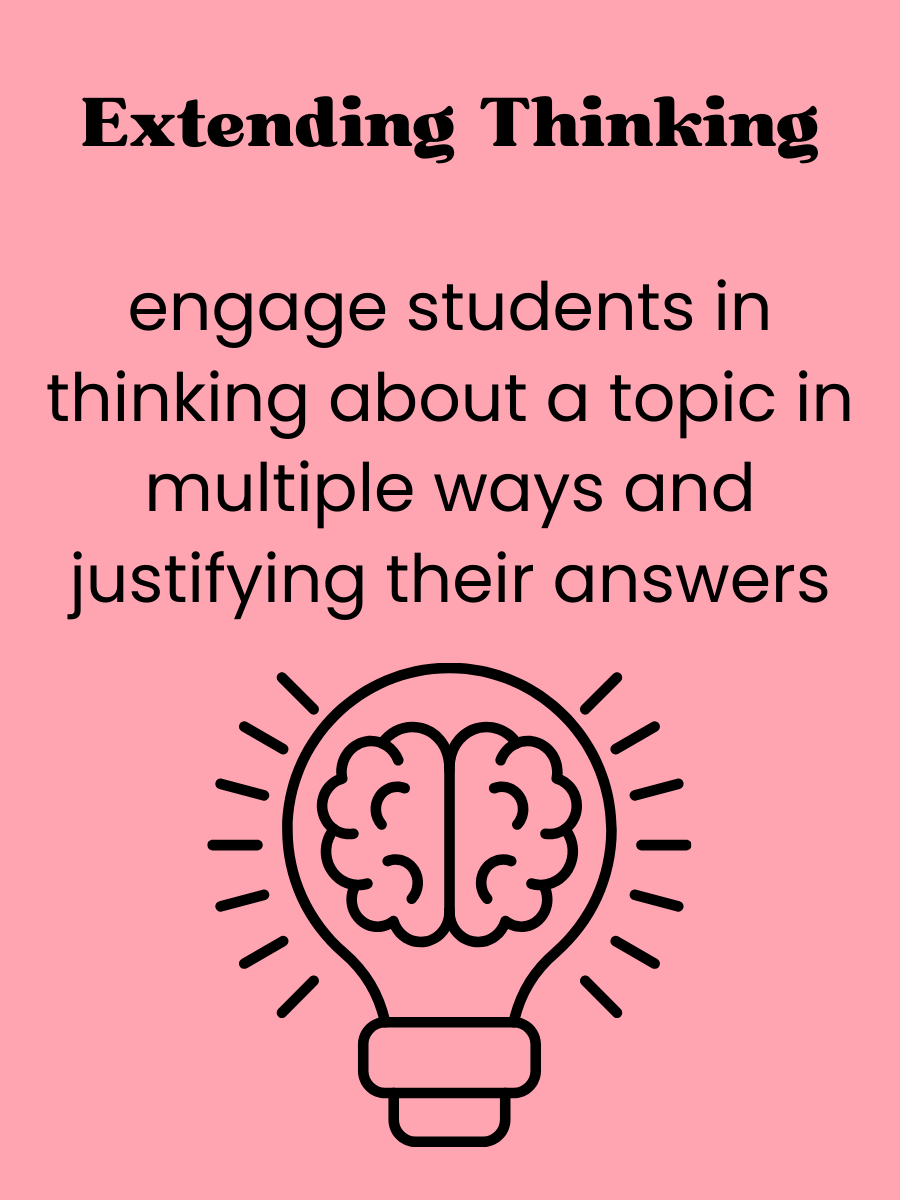
Extending Thinking instructional strategies are highly effective because they move students beyond surface-level understanding to deeper, more meaningful learning. Here's why they work:
1. Promotes Higher-Order Thinking
These strategies push students to analyze, evaluate, and create rather than simply recall information. This aligns with Bloom's Taxonomy's higher cognitive levels, building critical thinking skills essential for academic success and real-world problem-solving.
2. Develops Metacognitive Awareness
By encouraging students to think about their own thinking processes, these strategies help learners become more self-aware. Students learn to monitor their understanding, identify gaps in knowledge, and adjust their learning strategies accordingly.
3. Increases Student Engagement
When students are asked to extend their thinking through discussions, problem-solving, and creative tasks, they become active participants rather than passive recipients of information. This engagement leads to better retention and deeper understanding.
4. Builds Communication Skills
Strategies like Think-Pair-Share, debates, and structured discussions require students to articulate their thoughts clearly, listen to others, and respond thoughtfully. These communication skills are valuable across all subject areas and in life beyond school.
5. Encourages Multiple Perspectives
Extending thinking strategies often involve comparing ideas, considering alternatives, and exploring different viewpoints. This helps students develop flexibility in their thinking and appreciate diverse approaches to problems.
6. Supports Long-Term Retention
Research shows that deeper processing of information leads to better memory retention. When students engage in extended thinking, they create more neural connections and stronger mental frameworks for understanding.
7. Prepares Students for Complex Challenges
Real-world problems rarely have simple, straightforward solutions. Extending thinking strategies mirror the complex reasoning required in professional and personal contexts, better preparing students for future challenges.
8. Differentiates Instruction Naturally
Open-ended questions and problems allow students at different levels to engage meaningfully with content. Advanced learners can explore greater depth while struggling students can work at their current level, all within the same activity.
9. Fosters Curiosity and Lifelong Learning
By encouraging wonder, inquiry, and exploration, these strategies cultivate a love of learning that extends beyond the classroom. Students learn that learning is an ongoing process of questioning and discovery.
10. Improves Academic Achievement
Studies consistently show that students who regularly engage in higher-order thinking activities demonstrate better academic performance across subjects, stronger problem-solving abilities, and improved standardized test scores.
10 Extending Thinking Instructional Strategies
1. Think-Pair-Share
Students think independently about a question, pair with a partner to discuss their thoughts, then share with the larger group. This strategy builds confidence and allows processing time before public sharing.
2. Open-Ended Questioning
Ask questions that require more than yes/no or one-word answers. Examples include "Why do you think...?", "How would you solve...?", and "What if...?" These questions encourage students to explain their reasoning and explore possibilities.
3. Concept Mapping
Students create visual representations of how ideas connect to each other. This helps them organize information, see relationships, and build understanding of complex topics in a concrete, visual way.
4. "I Notice, I Wonder"
Students observe something (an image, object, text, or problem) and share what they notice and what they wonder about. This strategy develops observation skills and generates authentic questions for investigation.
5. Four Corners
Post different answers or perspectives in the four corners of the room. Students choose a corner that represents their thinking and discuss with others who made the same choice, then explain their reasoning to the class.
6. Socratic Circles
Students sit in a circle and engage in a structured discussion where they ask and answer questions about a text or topic. The teacher facilitates but students drive the conversation, learning to build on each other's ideas.
7. "What Would Happen If...?"
Present hypothetical situations that require students to predict outcomes and explain their reasoning. For example, "What would happen if it never rained?" This encourages cause-and-effect thinking and application of knowledge.
8. Justify Your Answer
After students provide an answer, always ask "How do you know?" or "Can you explain your thinking?" This requires students to articulate their reasoning process and defend their conclusions with evidence.
9. Problem-Based Learning Tasks
Present real-world problems that require students to apply multiple skills and concepts to find solutions. These authentic challenges motivate students and show them the relevance of what they're learning.
10. Gallery Walks
Display student work or different problems around the room. Students walk around to observe, reflect, and provide feedback or responses. This exposes students to multiple approaches and encourages them to analyze and compare different solutions.