
Maximizing Phonetic Knowledge Task Cards in Your 5th Grade Classroom
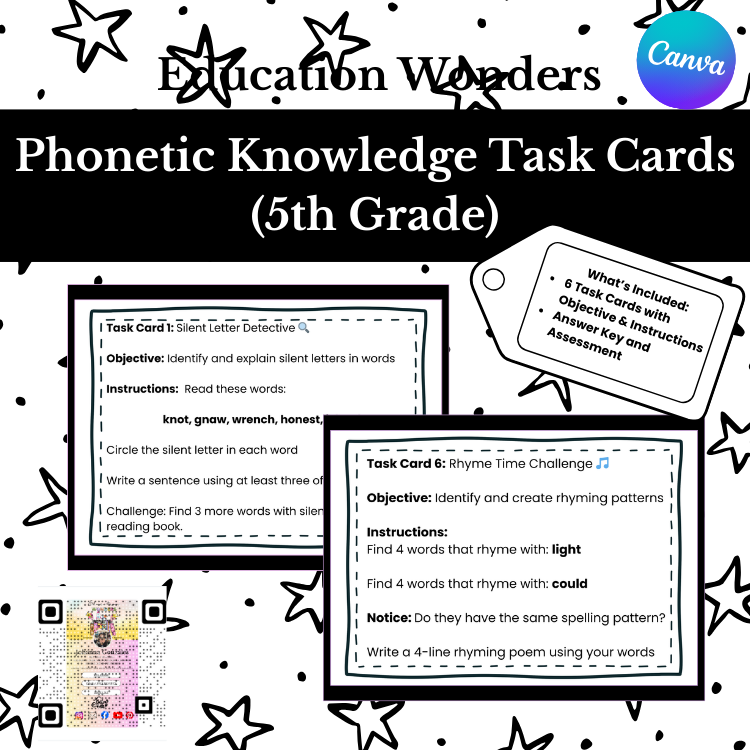
Making Phonics Practice Engaging and Effective
As 5th-grade teachers, we know that phonetic knowledge is foundational to reading fluency and spelling accuracy. But let's face it—traditional phonics worksheets can feel repetitive and uninspiring to our students. That's where these Phonetic Knowledge Task Cards come in! Here's how you can seamlessly integrate them into your classroom routine to boost engagement and learning outcomes.
🎯 Setting Up for Success
Preparation Tips:
Laminate for longevity: Print the task cards on cardstock and laminate them. This allows students to use dry-erase markers directly on the cards, making them reusable throughout the year.
Create a dedicated station: Set up a phonics task card center in your literacy rotation. Include dictionaries, whiteboards, and markers so students have everything they need at their fingertips.
Organize by skill level: While all cards are designed for 5th grade, you might find some students need to start with certain cards before others. Color-code or number them based on your students' needs.
💡 Implementation Strategies
1. Literacy Center Rotation
Incorporate the task cards into your existing literacy center rotation. Students can work through 3-4 cards per session, either independently or with a partner. This keeps the work fresh and prevents cognitive overload while allowing for deep practice with each phonetic concept.
2. Small Group Intervention
Use specific task cards to target skills your intervention groups need most. For example, if a group struggles with multisyllabic words, dedicate several sessions to Task Card 5 (Syllable Surgeon). The structured format allows you to guide students through the process before releasing them to independent practice.
3. Differentiation Made Easy
The beauty of task cards is their flexibility:
For struggling learners: Start with one task card at a time, providing additional modeling and support. Consider partnering these students with a peer buddy.
For on-level students: Have them complete the main instructions and one challenge per card.
For advanced learners: Encourage them to complete all challenges and create their own additional examples or even design a new task card for classmates.
4. Morning Work or Early Finisher Activities
Place a basket of task cards at an accessible location. When students arrive early or finish assignments ahead of schedule, they can grab a card and get started. This transforms wait time into productive learning time.
5. Homework Connections
Send home one task card per week as homework. This provides parents with a clear, structured way to support their child's phonics practice at home. Include a parent guide explaining the skills being practiced.
📊 Assessment and Accountability
Tracking Progress:
Create a checklist for students to track which task cards they've completed
Collect student work periodically to assess understanding and provide feedback
Use exit tickets asking students to demonstrate one skill from their task card work
Hold brief conferences where students explain their thinking and strategies
Peer Review:
Build in time for students to share their responses in small groups. This peer learning opportunity allows students to see different approaches and self-correct misconceptions. The discussion also reinforces the phonetic concepts through verbalization.
🎨 Making It Fun
Gamification Ideas:
Task Card Challenge: Create a classroom chart where students can move their name up as they complete cards
Phonics Passport: Give each student a "passport" that gets stamped when they complete a task card
Team Competition: Divide the class into teams and see which team can accurately complete all cards first
Mystery Card: Each week, select one "mystery task card" that's worth bonus points or a special privilege
🔄 Integration Across the Day
Don't limit these cards to just your literacy block:
Word Work Wednesday: Dedicate one day per week where task cards are the focus of your word study
Writing Workshop: After completing a task card, have students write a reflection or creative piece using their new words
Brain Breaks: Use quick task card challenges as energizing transitions between subjects
👨👩👧👦 Parent Communication
Help parents understand the value of this resource by:
Sending home sample task cards with explanations of the skills being practiced
Sharing success stories in your classroom newsletter
Inviting parents to literacy night where they can try the task cards themselves
Providing tips for how parents can reinforce these skills during everyday activities (grocery shopping, reading signs, etc.)
✨ Real Classroom Impact
Teachers who've implemented these task cards report:
Increased student engagement during phonics practice
More confident spellers who apply rules independently
Improved reading fluency as students decode unfamiliar words more
