
How to Use a Socratic Seminar in the Elementary Classroom (And Take Your Teaching to the Next Level)
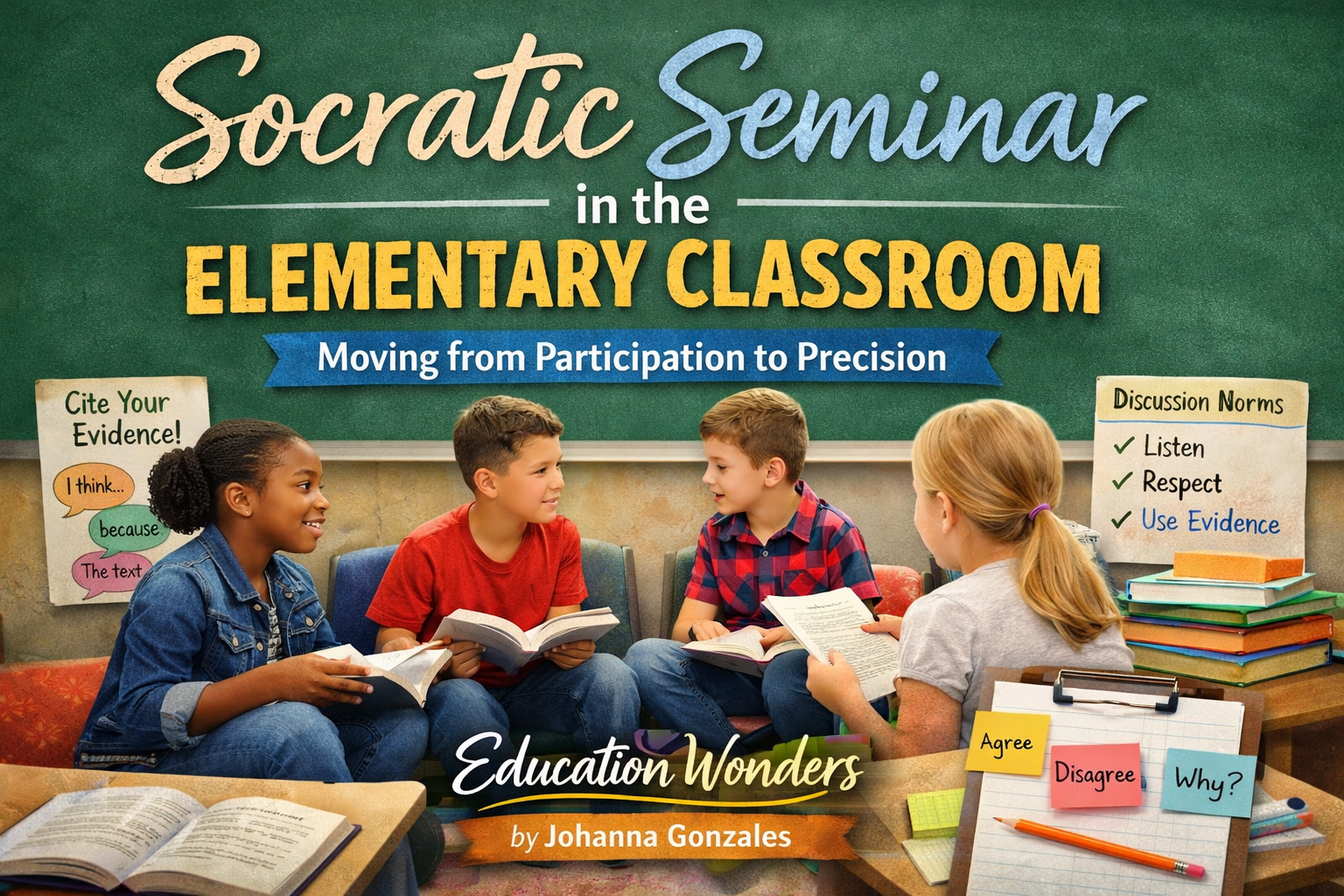
If you’ve been in the classroom for any length of time, you already know instructional strategies matter.
You’re not new.
You’ve tried think-pair-share.
You’ve done turn and talk.
You’ve facilitated small groups.
But if you’re ready to elevate the level of thinking in your classroom — not just manage discussion, but truly deepen it — then Socratic Seminar might be the next step for you. And yes… it absolutely works in elementary.
What Is a Socratic Seminar?
A Socratic Seminar is a structured, student-led discussion centered around a text or essential question. Instead of you leading the conversation, students respond to one another, ask questions, defend their thinking, and build on ideas using evidence. It moves students from:
answering the teacher
toresponding to each other
That shift alone changes the energy of your classroom.
Why Socratic Seminar Levels Up Your Instruction
If you’re already using solid instructional strategies, Socratic Seminar doesn’t replace them — it refines them.
Here’s what it elevates:
Student ownership – Students carry the thinking.
Accountability to the text – Evidence becomes non-negotiable.
Academic language development – Students practice speaking in complete, thoughtful responses.
Higher-level questioning – You move from recall to analysis and evaluation.
This strategy stretches your strong students and supports your developing ones — because everyone has to think.
Can Elementary Students Really Do This?
Yes. But it requires structure. In 3rd–5th grade classrooms, Socratic Seminar works beautifully when you:
Choose a short, rich text (fiction or nonfiction)
Pre-teach discussion stems
Model what accountable talk sounds like
Establish clear expectations
Elementary Socratic Seminar doesn’t look like a college philosophy circle.
It looks like:
Students sitting in a circle
Text in hand
Sentence stems posted
A focused essential question
Respectful disagreement
And the teacher? You step back and facilitate — not dominate. That’s the growth moment.
Step-by-Step: How to Run a Socratic Seminar
Here’s a simple structure you can implement this week:
1. Choose a Strong Essential Question
Not a “right or wrong” question. Think:
Was the character justified in their actions?
What was the author’s real message?
Which solution would have been more effective and why?
2. Prepare Students with Evidence
Before the seminar, students annotate or respond to 2–3 guiding questions. This prevents surface-level responses.
3. Teach Discussion Stems
Post stems like:
“I agree with ___ because…”
“I would like to add on to that idea…”
“Can you explain what you meant by…?”
“I respectfully disagree because…”
These stems are game changers in elementary.
4. Set Clear Expectations
Establish:
One voice at a time
Evidence is required
Listen to understand
Build on ideas
You may even use a simple participation tracker or checklist.
5. Facilitate, Don’t Control
Your role is to:
Ask clarifying questions
Redirect if necessary
Invite quieter students in
Keep the discussion anchored in the text
But resist the urge to answer for them. The magic happens in the struggle.
What It Looks Like in a High-Level Elementary Classroom
Students referencing text without prompting.
Students respectfully disagreeing.
Students asking each other for clarification.
Students changing their thinking after hearing new perspectives.
That’s academic maturity. And it can absolutely happen in your room.
Differentiation Tips
Because we know every classroom is different.
Provide sentence frames for emerging readers.
Allow written thinking time before speaking.
Use inner/outer circles if you have a large class.
Assign roles (facilitator, evidence tracker, summarizer).
Socratic Seminar can stretch high flyers and scaffold struggling learners at the same time.
Why This Matters for You as the Teacher
You already know strategies. But the difference between a good classroom and a powerful classroom is intentional strategy use. Socratic Seminar isn’t just another activity. It’s a shift in instructional mindset.
And when you consistently implement high-impact strategies like this, your classroom becomes a place where students think independently — not just respond compliantly. That’s next-level teaching.
Want More Strategies Like This?
Inside the Education Wonders Membership, you don’t just get random ideas. You get access to:
Over 50 classroom-tested instructional strategies
Quick Lessons you can use any day of the week
Grade-level Learning Objectives
A growing Resource Library
A Members-Only Facebook Community
Ongoing blog support and instructional insight
It’s like having your own personal instructional coach at your fingertips.
If you’re the teacher who already knows the basics — but wants to refine, elevate, and lead your classroom with confidence — this space was built for you. Because strong teachers deserve strong support.
